Sky Dragon Expeditions

Practical

Travel questions

Everything we are actually asked, answered properly. If your question is not here, send it to us — we would rather answer it than have you guess.

Entry, visas and fees

Entry, visas and fees

Do I need a visa, and how do I get one?
Yes, unless you hold an Indian, Bangladeshi or Maldivian passport, for which different arrangements apply. The visa fee is US$40 per person, one-off and non-refundable. You may apply directly through Bhutan's official online system, or a tour operator or hotel can apply on your behalf. If you travel with us we make the application as part of your booking. Indian nationals travel without a visa but require a permit.
What is the Sustainable Development Fee?
A levy set by the Royal Government of Bhutan, charged for every night you spend in the country. The current rate is US$100 per adult per night, US$50 for children aged six to twelve, and nothing for children under six. Indian nationals pay Nu. 1,200 per person per night. This rate has been confirmed to 31 August 2027. It is included in every quotation we send, never added afterwards.
Is travel insurance compulsory?
It is not a condition of a Bhutan visa. We strongly recommend it for any trip, and we require it as a condition of booking on our trekking itineraries, where evacuation from a remote camp is slow and expensive. Make sure any policy you buy covers the maximum altitude of your itinerary.
Do I need permits to travel around the country?
Ordinary travel through Bhutan's dzongkhags does not require a separate route permit for visitors travelling with a tour operator. Some restricted areas, certain high trekking routes and some monasteries still need specific permission, which we arrange. If a permit is needed for your itinerary we will tell you at the quotation stage.
Do I have to travel with a guide?
In practice, yes — international visitors travel with a licensed Bhutanese guide, and the guide is included in every itinerary we quote. It is less of a restriction than it sounds: most of what makes a dzong or a temple interesting is not written on a sign anywhere.
Getting there and getting around

Getting there and getting around

How do I get to Bhutan?
Paro International Airport is the principal gateway, served by Drukair and Bhutan Airlines from a limited number of regional cities. It is not the country's only airport, and aviation infrastructure is being expanded. You can also enter by road at recognised border points including Phuentsholing, Samtse, Gelephu and Samdrup Jongkhar — though which are open to international visitors can change, and requirements vary by nationality.
Which side of the plane should I sit on?
Flying into Paro from the west — Delhi, Kathmandu — the Himalayan range is on the left. On a clear morning you can see Everest, Kangchenjunga and, closer in, Jomolhari. Ask for a left window seat and check in early.
Are there domestic flights?
Yes, to Bumthang (Bathpalathang), Yonphula in the east and Gelephu in the south. Schedules are limited, seasonal, and weather cancellations happen — we always plan a road contingency around a domestic flight rather than relying on it.
How bad are the roads?
The main east–west highway has been widened and surfaced in stages and most of it is now good. It is still a mountain road: forty kilometres can take two hours, and monsoon landslides cause delays between June and September. Our driving times assume normal conditions and we build in slack.
On the ground

On the ground

How much walking is involved?
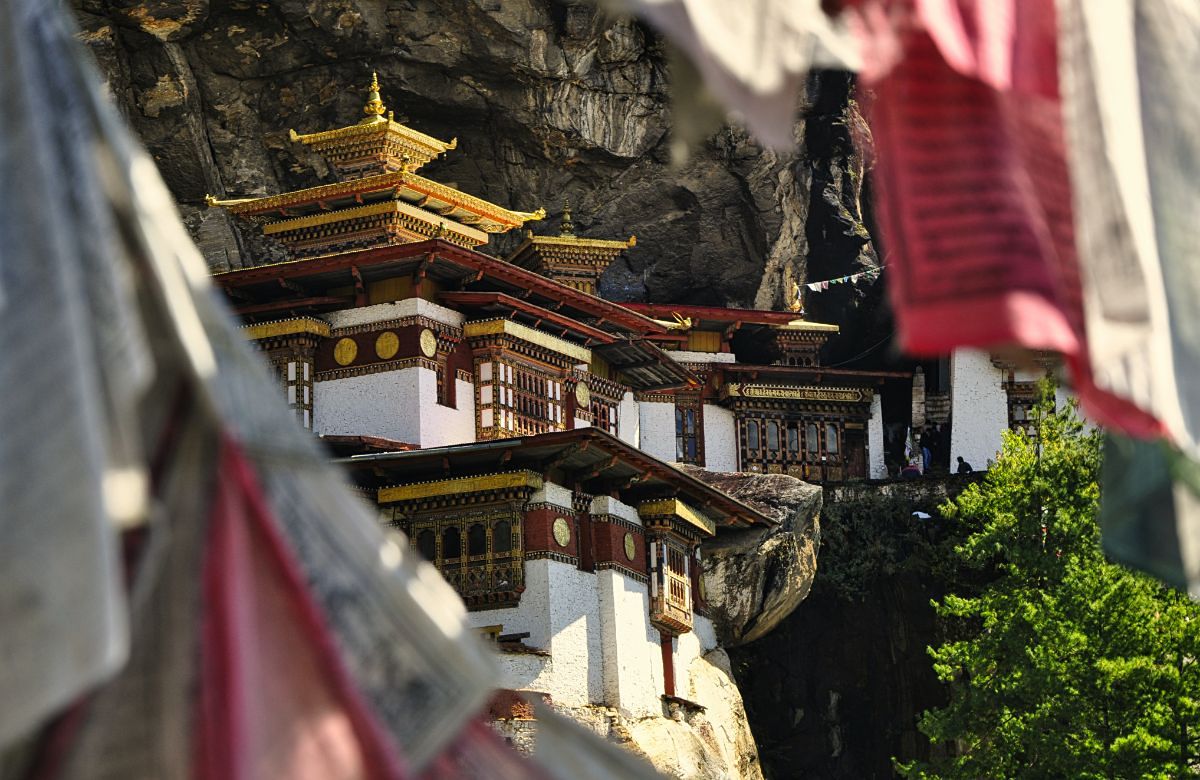
It depends entirely on the itinerary. Cultural routes involve short walks of one to two kilometres a day, with one demanding exception — the climb to Paro Taktsang, four to five hours return with about 900 metres of ascent. Trekking itineraries are a different proposition and are described day by day on each page.
Will I get altitude sickness?
On the standard cultural routes, almost certainly not — you sleep no higher than about 2,600 metres and the high passes are day visits of an hour or two. On the treks it is a genuine consideration: you sleep above 4,000 metres for several consecutive nights, which is why those itineraries include acclimatisation days that are not optional.
What should I pack?
Layers, in every season. Valley days can be warm while the passes are near freezing, and the temperature drops sharply after sunset year-round. Bring broken-in walking shoes with grip, a warm mid-layer, a waterproof shell, sun protection and a hat. Shoulders and knees should be covered in temples and dzongs, and hats and shoes come off inside.
What is the food like?
Chillies are treated as a vegetable rather than a seasoning — ema datshi, the national dish, is chillies and cheese. Hotel kitchens cook a milder buffet for visitors as a matter of course, usually with Indian and Chinese dishes alongside Bhutanese ones. Vegetarians are well served. Tell us about allergies or dietary requirements at the enquiry stage and we will brief every kitchen on the route.
What currency is used, and can I pay by card?
The ngultrum, pegged to the Indian rupee, which is also widely accepted. Cards are taken in larger hotels and some shops in Thimphu and Paro, but far from everywhere. Carry cash for handicrafts, tips and small purchases. ATMs exist in the main towns and are not always reliable.
Is there mobile signal and wifi?
Mobile coverage is good in the valleys and along the main road, and patchy to absent on the treks and in the far east. Hotels have wifi; its speed varies enormously. We include a local SIM card on arrival.
Is Bhutan safe?
Bhutan has a very low crime rate and solo and female travellers generally report feeling comfortable. The real risks are road accidents on mountain roads, altitude on the treks, and stomach upsets — none exotic, all worth insuring against.
Booking with us

Booking with us

Why do you not publish prices?
Because a private trip priced honestly depends on your dates, the size of your group, how many nights you want in each valley and which hotels you choose. A single published figure would be either wrong or padded. Send us those details and you will get a real number, with the Sustainable Development Fee and the visa fee already inside it.
Is Bhutan suitable for children, or for older travellers?
Both, with the right pacing. Children under six are exempt from the Sustainable Development Fee and six to twelve pay half, which makes family travel more affordable than people expect. For older travellers the constraints are the driving times and the Taktsang climb, and both can be planned around — shorter driving days, more nights in each valley, and the halfway cafeteria instead of the full ascent.
Can you arrange a trip for one person?
Yes. Every departure is private, so a solo trip is simply a private trip for one. The per person cost is higher than for a couple because the vehicle, guide and driver are the same either way — that is arithmetic rather than a supplement we have invented.
How far ahead should I book?
For festival dates and the spring and autumn high seasons, as far ahead as you can — good hotels in Paro, Thimphu and Bumthang fill months in advance. For the monsoon and winter, a few weeks is usually enough. Treks need longer because crew and pack animals are arranged in advance.

If you are unsure, ask

Government fees, entry requirements and border arrangements can change, and we reconfirm them before every departure. If something here does not match what you have been told elsewhere, ask us and we will check it rather than guess. Itinerary-specific questions are answered on each journey page.

Still have a question?

Send it. We answer every enquiry ourselves, and there is no obligation at any point before you choose to confirm.